Casa Paraula Publications
Is selling CBD flower a crime in Spain after Supreme Court ruling STS 301/2026? Dose, cannabis and THC
Spain’s Supreme Court has convicted a CBD flower trader of drug trafficking over products containing 0.3–0.7% THC. The Provincial Court had acquitted him. Judgment STS 301/2026 of 23 April has alarmed the entire sector. But it leaves doors open for the defence, and its reasoning is, in our view, open to serious objections.
The case
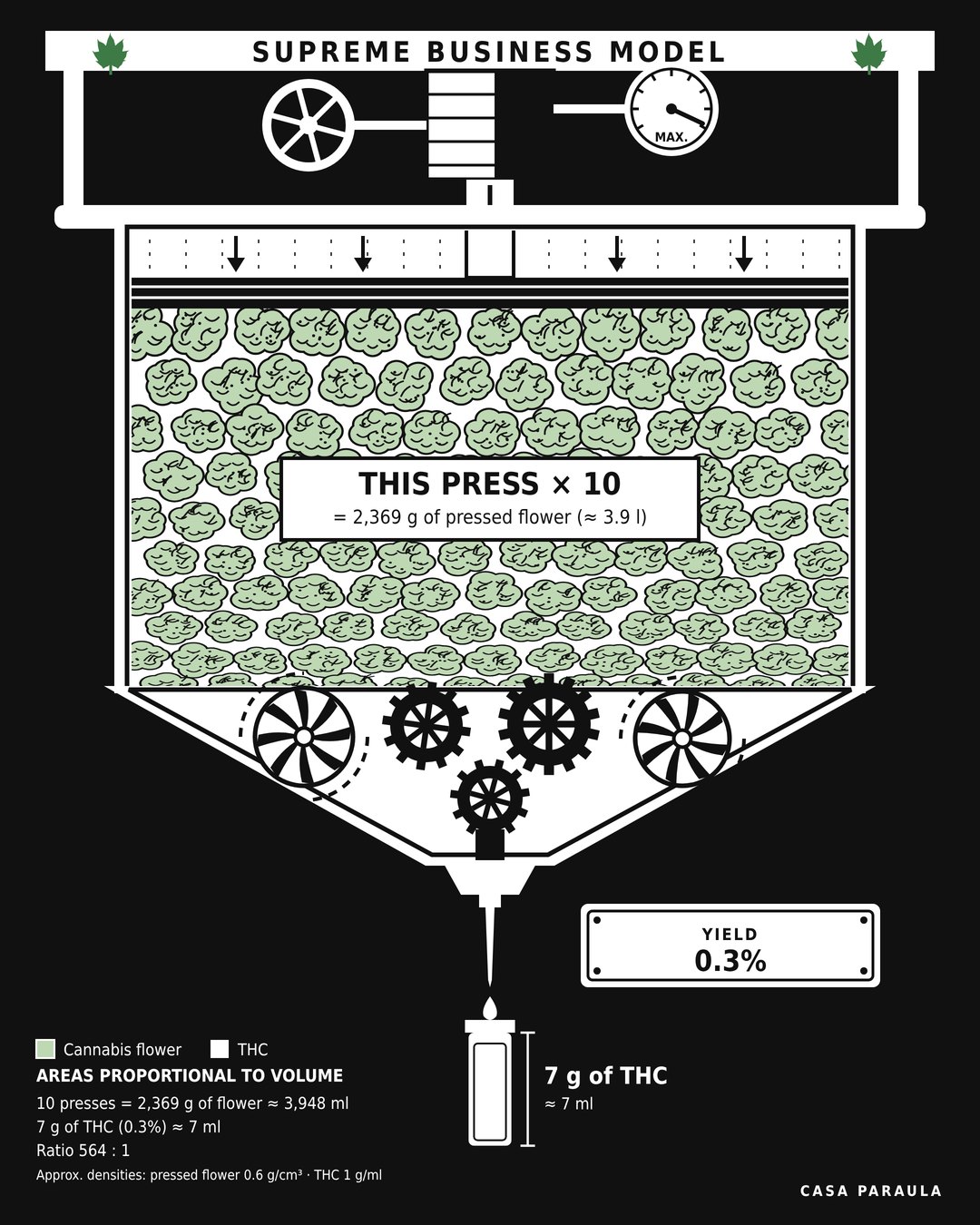
Customs intercepted two parcels bound for France: 1,190 cigarettes, 140 cigarillos, 1 g and 2.5 g bags and buds marketed as CBD. Net weight: 2,369 grams. THC content: between 0.3% and 0.7%.
| Court | Outcome |
|---|---|
| Barcelona Criminal Court No. 18 | Conviction: 1 year and 2 months’ imprisonment and an €8,000 fine |
| Barcelona Provincial Court, Section 6 | Acquittal |
| Supreme Court (appeal by the Public Prosecutor) | Conviction: first-instance sentence reinstated |
The Provincial Court acquitted for two reasons. Experts from the National Institute of Toxicology and the Extremadura Agri-Food Technology Centre testified that the substance lacked psychoactivity. And the United Nations Office on Drugs and Crime index, (THC+CBN)/CBD, did not exceed 1.
What the Court says
The Supreme Court does not dispute the lab results. It rejects the idea that a laboratory formula can define the offence: “Science tells us what substance exists; the law decides what criminal relevance it should be given.”
To convict, the Court combines five factors:
- The plant material consisted of cannabis flowers, not a CBD isolate.
- Laboratory analysis had confirmed that the flowers contained THC.
- The total THC in the flowers was above the minimum psychoactive dose of 10 mg.
- Consumer formats: cigarettes, cigarillos, buds.
- Supply to third parties in exchange for money.
On top of this, it adds that the 0.2% THC limit, which belongs to the agricultural sphere, “does not thereby become a self-sufficient criminal rule”. And that the CJEU’s Kanavape judgment protects the free movement of CBD, not the sale of flower containing THC.
The defence then asked the Court to rule on mistake of law, the Kanavape judgment and the fine. The Supreme Court refused by order of 19 June 2026 (AATS 6796/2026). The established facts recorded no mistake, and the defence had not challenged them, not even by way of a cross-appeal.
The doors STS 301/2026 leaves open
The judgment is harsh, but it does not close the debate. The Court itself acknowledges several points the defence can use from today:
- Lawful industrial hemp exists. “All hemp is cannabis, but not all cannabis is industrial hemp in the legal-administrative sense” (Legal Ground 4.4). The Court does not condemn the sector as a whole: it requires a case-by-case distinction.
- The THC percentage is not enough. On its own it does not turn the flower into a narcotic (Legal Ground 4.3). It must be proven that the product is criminally relevant cannabis.
- There is no automatic threshold. The agricultural 0.2% is not a self-sufficient criminal rule, and neither is any other percentage.
- The established facts decide. The clarification order shows that the lack of psychoactivity must be recorded in the established facts and defended on appeal to the Supreme Court, including by way of a cross-appeal.
A single judgment is not case law. The Spanish Civil Code reserves that status for “the doctrine repeatedly established by the Supreme Court” (art. 1.6). The Court itself applies that standard: it rejects the UN index because it has not been endorsed “by consolidated case law”.
Nor do courts amend the law. Judges are subject “solely to the rule of law” (art. 117.1 Spanish Constitution). Criminal law punishes trafficking in toxic drugs, narcotics and psychotropic substances (art. 368 Criminal Code). It sets no percentages or thresholds. Whether a substance falls within it remains a matter of evidence, case by case.
In practice, each court will continue to weigh the expert evidence in the specific case. In the coming weeks we will publish recent acquittals that prove it. The first: Is selling CBD flower a crime in Spain? The reasonable doubt that acquits.
Objections to the reasoning of STS 301/2026
The authority of the Supreme Court does not mean it is infallible, nor that all its decisions must be accepted uncritically. With all due respect to the Court, the legal objections that, in our view, should prevent its propositions from becoming settled case law deserve to be set out.
Cannabis or THC?
Cannabis contains THC, but it is not THC. They are different substances, and international law regulates them differently.
| Cannabis | THC (delta-9-tetrahydrocannabinol) | |
|---|---|---|
| Treaty | 1961 Single Convention on Narcotic Drugs, Schedule I | 1971 Vienna Convention on Psychotropic Substances, Schedule II |
| Definition | “The flowering or fruiting tops of the cannabis plant” from which the resin has not been extracted | Chemical substance, natural or synthetic (dronabinol) |
| Spanish law | Narcotics Act 17/1967 | Royal Decree 2829/1977 on psychotropic substances |
The separation is deliberate and significant. Indeed, in December 2020 the WHO proposed moving THC to the 1961 Convention, but the UN Commission on Narcotic Drugs rejected it: 28 votes against and 23 in favour.
A basic principle of interpretation applies here: what the law distinguishes cannot be treated the same (ubi lex distinguit, nos distinguere debemus). In criminal law it also carries an express guarantee: “criminal laws shall not be applied to cases other than those expressly covered by them” (art. 4.1 Spanish Criminal Code). In our view, the judgment departs from the text of the law, interpreting it against basic legal principles to transmute a finding of cannabis into one of THC. Measuring cannabis by the THC threshold treats as equal two substances the law regulates separately.
The Court itself acknowledges the difference when it states that the THC percentage measures potency “once it has been established that we are dealing with criminally relevant cannabis”. And it adds that it “does not by itself create the legal concept of a narcotic, nor can it undo it by means of a simple arithmetic operation” (Legal Ground 4.3).
That raises a question. If THC does not create the concept of a narcotic, is it legally valid to multiply 2,369 grams of industrial hemp flower by its meagre THC content to conclude that there is a drug that has neither been extracted nor could viably be extracted (Legal Ground 7.2)?
In our view, the answer is no, for three reasons:
- It departs from the will of the legislator. Cannabis flower does not become THC. The legislator distinguishes them deliberately and expressly, and the interpreter cannot merge them.
- It has no scientific basis. Adding up the THC in an entire seizure would only make sense if someone were going to extract and concentrate it. At such low concentrations, the cost in energy, staff and storage makes that extraction unviable.
- It presumes an intention without evidence. Treating the flower as accumulated THC assumes the defendant intended to transform it. That is not compatible with the presumption of innocence (art. 24.2 Spanish Constitution) or with the principle that good faith is presumed and bad faith must be proven (art. 434 Spanish Civil Code).
Dose or seizure?
The minimum psychoactive dose answers a specific question: can this dose produce an effect in the person who consumes it? The State’s severe punitive response is only justified by an effective threat to public health, that is, by the substance’s real capacity to produce the harmful effects typical of a drug and to cause addiction. For cannabis with less than 1% THC and a higher CBD content, scientific studies rule out that capacity.
The judgment takes as its reference the minimum psychoactive dose of THC (a substance that was not seized), set at 10 mg. It then extrapolates the total amount of THC that could be obtained from harmless flowers and concludes that the flowers as a whole exceed that dose. But obtaining that THC would require transforming the flowers, and that transformation requires technical means, logistics and an investment of time and energy that make it unviable and entirely hypothetical. This is hard to reconcile with the rules of logic and common experience.
The tables of the National Institute of Toxicology set the minimum psychoactive dose of THC at 10 mg. The seized flowers do not reach that dose or barely touch it, even before allowing for the fact that combustion releases only a small part of the THC the plant contains:
| Unit of consumption | THC | THC content | Reaches 10 mg? |
|---|---|---|---|
| 1 g bag | 0.5% | 5 mg | No |
| Usual 1.5 g dose | 0.3% | 4.5 mg | No |
| Usual 1.5 g dose | 0.7% | 10.5 mg | Borderline |
Since the dose does not reach the threshold, the Court gets around the obstacle by adding up the potential THC in everything seized: 2,369 grams.
On that calculation, 3.3 grams of flower at the EU-authorised 0.3% THC already add up to a theoretical 10 mg. The threshold no longer distinguishes between what has an effect and what does not. And the psychoactivity the experts denied at trial is replaced by an arithmetic operation.
However, this operation is legally objectionable on two grounds:
Breach of law through the improper application of the 1961 Single Convention and, above all, the 1971 Vienna Convention. While THC is in the flower, legally it is cannabis, governed by the Single Convention. It only becomes “THC”, the substance covered by the Vienna Convention, once it is separated from the plant. By multiplying the grams of flower by their THC percentage, the Court applies to the flowers the regime of a substance that was never seized: it calculates how much THC would be obtained if it were extracted.
Infringement of the right to a fair trial with all safeguards (art. 24.2 Spanish Constitution). The charge was possession of cannabis flowers intended for trafficking. Yet the Court’s reasoning implicitly attributes to the defendant the intention of transforming the flowers to extract and obtain THC present in very low concentrations. The judgment does not say so, but it convicts as if that were the case, contrary to the accusatorial principle. No one alleged or proved that intention, and no tools, machinery or products to carry it out were seized. This leaves the defence defenceless: it never had the opportunity to challenge that hypothesis or to prove that extraction was unviable at such low concentrations. This infringement would open the door to an appeal for constitutional protection (recurso de amparo) before the Constitutional Court.
What a business in the sector should do today
- Document every batch. EU catalogue variety, seed certificate, invoice and cannabinoid analysis from an accredited laboratory.
- Make sure your products lack narcotic potential by their nature. Some hemp flowers are not controlled substances and others are, depending on several factors: origin, processing, chemical composition. Seek professional advice in a field with great legal and product variability.
- Review your format. The Court gives weight to presentation for consumption (cigarettes, cigarillos, buds). The criminal risk is not the same for every product.
- Prepare the expert evidence from day one. If goods are seized, the lack of psychoactivity must be proven through experts and recorded in the established facts. That is what the Supreme Court cannot review.
- Know the rights that limit inspections. Constitutional rights shape and limit the authorities’ inspection activity, which in this field is sometimes indiscriminate: inviolability of the home, the right to a defence and the right to remain silent. That is our job.
Have your goods been seized? Need legal advice?
For 20 years we have defended the hemp sector, taking part in legislative initiatives and working closely with leading experts: agronomists, psychologists and pharmacology researchers. We can help.
Phone: +34 93 742 10 56 · WhatsApp: +34 607 93 76 91 · Email: info@casaparaula.com
By Oriol Casals Madrid, criminal defence lawyer (Barcelona Bar Association No. 32430), founder of Casa Paraula. 20 years practising criminal defence and cannabis law; drafter of the Catalan cannabis associations law and director of legal projects at the Civil Observatory on Drug Policy.
Sources: STS 301/2026, 23 April · AATS 6796/2026, 19 June (in Spanish).


