Casa Paraula Publications
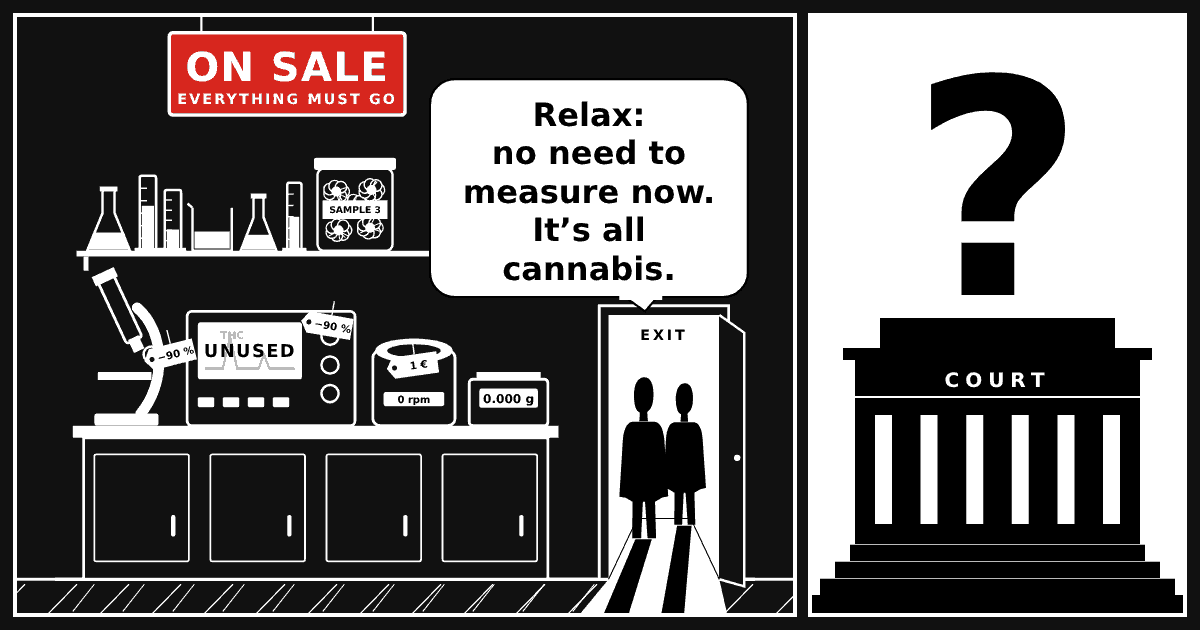
Is selling CBD flower a crime in Spain? The reasonable doubt that acquits
The Public Prosecutor sought 3 years’ imprisonment and a 5-year closure of the shop. With 0.2–0.8% THC and up to 17.3% CBD, it was not proven that the flowers were a drug. Reasonable doubt: acquitted. Final judgment, April 2026.
The case: a shop, 540 grams and 3 years in prison
The local police inspected a vape shop in Barcelona that also sold CBD flower, both in store and online. Officers seized 540 grams of CBD buds in 10 samples, along with bags ready for sale in individual portions.
Official analysis by the National Institute of Toxicology: six samples with THC levels between 0.2% and 0.8% and a high CBD content (between 9.4% and 17.3%). The other four contained only CBD. A later clarifying report added that some samples were consistent with fibre-type hemp.
The Public Prosecutor charged the owner with an offence against public health (Article 368.1 of the Spanish Criminal Code) and sought 3 years’ imprisonment, a €6,000 fine and the closure of the shop for 5 years.
The Criminal Section of the Barcelona Court of First Instance acquitted him. The judgment is final.
The question
The defence did not challenge the analysis, nor did it dispute that the products were hemp flowers intended for sale. The question was a different one: could they be classed as a narcotic drug?
The presence of THC is not enough either. Under Article 368 of the Criminal Code, a drug is only a substance capable of producing its characteristic effects. That depends on the active ingredient and on its capacity to harm health. The court put it this way:
“The mere presence of THC is not synonymous with being a narcotic substance.”
And proving that capacity is the prosecution’s job.
The evidence: the report that changed
The official report. The National Institute of Toxicology measured the THC and CBD in each sample. With those figures, the psychoactivity index was below 1 in every sample containing THC. The prosecution itself had supplied that data.
The defence expert. A professor of organic chemistry testified that, given the values in the report, the substance had no psychoactive potential: it was industrial, fibre-type hemp, and CBD counteracts the effect of THC.
The twist at trial. An official laboratory report that no party challenges counts as documentary evidence (Article 788.2 of the Criminal Procedure Act): its authors did not need to appear at trial. The Public Prosecutor asked them to appear, and at the hearing the experts unexpectedly said they wanted to change their report.
| Stage | What the Institute said |
|---|---|
| Initial report | Quantifies THC and CBD: psychoactivity index < 1 in every sample containing THC |
| Clarifying report | Some samples are consistent with fibre-type hemp |
| At trial | Does not ratify the clarification. No longer applies the index or takes THC into account, “even though they were quantified in the initial report”. Any flower would be cannabis, regardless of its concentration or its capacity to cause harm |
The defence’s response. It asked the experts whether there was an agreement between the Institute and the Public Prosecutor to maintain that the concentration of the active ingredient was irrelevant, and it questioned the objectivity of a report modified at the prosecution’s request. It also made the key point: a scientific report had turned into a legal assessment, which is for the judge to make.
The judge relied on the measurements. On the actual psychoactivity of the substance, the experts “put forward nothing”.
Reasonable doubt
The court concluded that there was, at the very least, reasonable doubt as to the narcotic nature of the substance. The evidence “does not make it possible to rebut the presumption of innocence”.
With low-concentration hemp flower, it is the only logical conclusion:
- Not even the official laboratory could establish psychoactivity. Its own measurements gave an index below 1.
- Per unit of consumption, there is no psychoactive dose. A 1 g bag at 0.8% contains 8 mg of THC: below the 10 mg minimum psychoactive dose, even using the Institute’s own table.
- The burden of proof lies with the prosecution. If it does not prove the capacity to cause harm, the presumption of innocence (Article 24.2 of the Spanish Constitution) requires an acquittal.
Trials are won when the evidence is examined. And in these offences, the evidence is expert evidence.
Why measuring matters: the 1961 Convention
Hemp flowers are not always controlled substances. The 1961 Single Convention defines cannabis as the flowering tops “from which the resin has not been extracted” (Article 1.1.b) and does not apply to cultivation exclusively for industrial purposes (Article 28.2). The treaty draws distinctions: not every flower is controlled by definition.
The actual presence of a narcotic substance in the flower is an essential condition for its control. According to its preamble, the purpose of the Convention is to protect health against addiction, not to pursue products with no psychoactive capacity.
That is why each flower must be analysed. Saying that it “is controlled” is not a laboratory result: it is a legal conclusion, and that is for the judge.
In the news. Barcelona City Council wants to “tackle this business” — around 250 shops — by reducing demand. It has launched a campaign against products containing semi-synthetic cannabis derivatives, following a rise in tourists needing medical care after taking gummies and vapes, and has announced inspections (La Vanguardia, 13 October 2026, in Spanish). According to the same report, Hospital Clínic treated 24 low-intensity poisonings in one year, twice as many as two years earlier. But the risk does not lie in the shops or in the word “cannabis”: it lies in the psychoactive potency of each product. A hemp flower with 0.2–0.8% THC and a psychoactivity index below 1 is not a semi-synthetic gummy. That is why we need to measure: treating everything as “cannabis” lumps together what harms health and what does not.
What about STS 301/2026?
On 23 April 2026, 16 days after this judgment, the Supreme Court convicted a defendant for sending CBD flower with between 0.3% and 0.7% THC to another country. The Court added up the THC in everything seized and compared it with the minimum psychoactive dose. We analyse it in Is selling CBD flower a crime in Spain after STS 301/2026?
Using that method, the six THC-containing samples from this shop would add up to about 2.6 grams of THC. Measured per unit of consumption, as this court did, the result is the opposite.
Same product, same dates, opposite answers. Two points are worth making:
- A single judgment does not create case law. Only the Supreme Court’s repeated doctrine complements the legal order (Article 1.6 of the Civil Code).
- Article 368 of the Criminal Code sets no thresholds. The nature of the substance must be proven case by case, with evidence. If the prosecution does not prove psychoactivity, the doubt benefits the accused.
Not an isolated case
It is not the first. In 2023, another court acquitted the owner of a shop in Palma de Mallorca holding more than 5 kg of flower with less than 1.25% THC. In both cases, the court assessed psychoactivity product by product, without adding up the THC in the whole seizure.
Download the judgment (anonymised PDF, in Spanish): Judgment 200/2026, Barcelona
Have your goods been seized?
For 20 years we have defended the hemp and cannabis sector, taking part in legislative initiatives and working closely with leading experts: agronomists, psychologists and pharmacology researchers. We can help.
Phone: +34 93 742 10 56 · WhatsApp: +34 607 93 76 91 · Email: info@casaparaula.com
By Oriol Casals Madrid, criminal defence lawyer (Barcelona Bar Association No. 32430), founder of Casa Paraula. 20 years practising criminal defence and cannabis law; drafter of the Catalan cannabis associations law and director of legal projects at the Civil Observatory on Drug Policy.
Sources: Judgment 200/2026 of 7 April, Criminal Section of the Barcelona Court of First Instance (anonymised PDF) · 1961 Single Convention on Narcotic Drugs, Articles 1.1.b) and 28.2 · INTCF table of minimum psychoactive doses · STS 301/2026, 23 April (in Spanish).


